Map symbols make it possible to fit a large place onto a small page. A tree can represent a park, a blue line can represent a river, and a small star can mark an important location. The legend explains what those choices mean.
Students understand this best when they first see symbols as a solution to a design problem. Instead of beginning with vocabulary definitions, ask: How could we show everything in our classroom without drawing every object exactly as it looks?
Start with familiar objects
Choose four or five classroom features: a table, bookshelf, sink, door, and rug. Ask students to sketch tiny versions that could fit on a map.
Compare the sketches. Some students will draw detailed pictures; others will use simple shapes. Discuss which symbols are easiest to recognize when they are small.
Build a class legend together:
| Symbol | Meaning |
|---|---|
| Blue rectangle | Rug |
| Brown line | Bookshelf |
| Circle | Table |
| Broken line | Doorway |
Explain that a map symbol stands for a real feature and a legend, sometimes called a key, tells the reader what each symbol means.
Separate symbols from labels
Students sometimes think any word on a map is part of the legend. Show the difference:
- A label names a specific place, such as “Library.”
- A symbol is a visual mark used to represent a type of feature.
- A legend explains the symbols used on that map.
A map may use both. A school could be shown with a small building symbol and also labeled with the school’s name.
The free Map Type Match game gives older elementary students repeated practice noticing how titles, legends, colors, lines, patterns, and symbols change with a mapmaker’s purpose.
Let students design before they decode
Creating a legend helps students understand why one is needed. Give students a simple blank map with several locations and ask them to invent symbols for each one.
Useful design rules:
- Keep the symbol simple enough to draw more than once.
- Make different symbols easy to tell apart.
- Use color only when the map will be printed or viewed in color.
- Include every symbol in the legend.
- Use the same symbol consistently across the map.
After students create their maps, exchange them with partners. If a partner cannot interpret a symbol, the designer revises the map or legend. That turns clarity into a real communication goal.
Compare conventional and invented symbols
Some map symbols are widely recognized: blue often represents water, a line can represent a road, and a star may mark a capital or important place. Others are specific to one map.
Avoid teaching conventions as unbreakable rules. Instead, ask:
- Why might a mapmaker choose blue for water?
- What could make two road symbols confusing?
- When would a picture symbol be more useful than a geometric shape?
- Why must the reader still check the legend?
Students should learn to use familiar clues while understanding that the legend is the final authority.
Use maps with a clear purpose
Once students can create a simple legend, give them maps that solve different problems:
- A zoo map for finding exhibits
- A park map for locating trails and restrooms
- A weather map with symbols for conditions
- A transit map with lines and stations
- A physical map with color showing elevation
Ask students what each symbol helps the reader do. This shifts the lesson from “name the symbol” to “use the symbol to answer a question.”
Add scale and detail gradually
Young learners may become overwhelmed when a map includes many symbols. Begin with no more than five. Add complexity in stages:
- Two or three obvious picture symbols
- A simple legend
- Repeated symbols across the map
- Symbols that are more abstract
- Color categories or patterned areas
- A map with labels, directions, and scale in addition to the legend
Students who struggle can cover part of the map and work with one section at a time.
Ask questions that require interpretation
Move beyond “What does this symbol mean?” with questions such as:
- Which route passes two picnic areas?
- Where could a visitor find water closest to the playground?
- Which symbol appears most often?
- What feature is missing from the legend?
- Which two symbols might be confused, and how could the mapmaker improve them?
These questions treat the map as information rather than decoration.
Watch for common errors
The legend does not match the map
Have students place a small check beside each legend symbol every time it appears on the map. Then ask them to look for any map symbols that are not explained.
Every object gets a different symbol
A useful map groups similar features. All restrooms should use the same restroom symbol unless there is a reason to distinguish them.
The symbol is too detailed
Shrink the map or ask students to redraw the symbol three times quickly. If it becomes unreadable, simplify it.
Color carries all the meaning
Some users may see a black-and-white copy or have difficulty distinguishing colors. Pair color with shape, pattern, or a clear label when possible.
Use a quick creation-and-reading assessment
Ask students to add three symbols to a small map, create a matching legend, and answer two questions using a partner’s map. This checks both sides of the skill: communicating as a mapmaker and interpreting as a map reader.
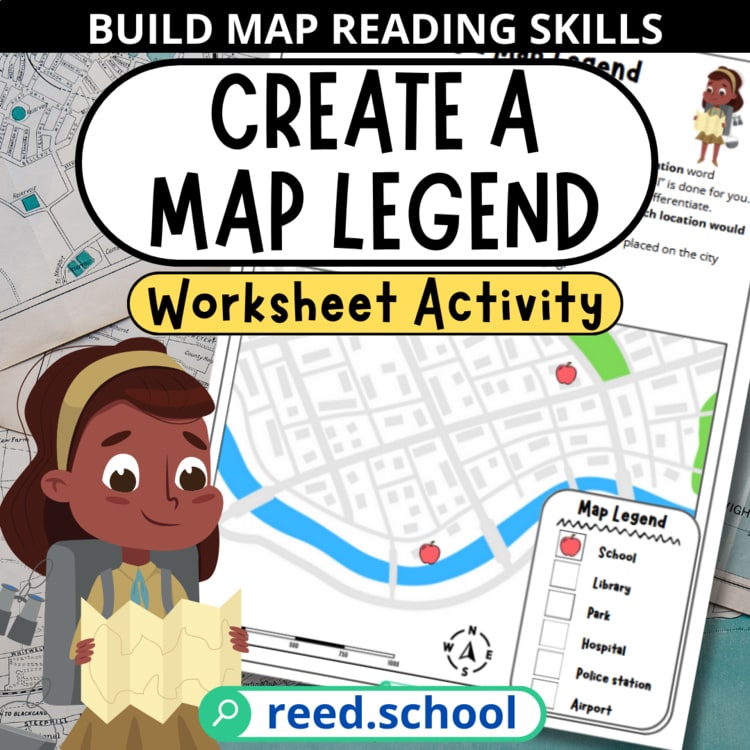
The free Create a Map Legend & Key activity gives students a ready-made space to practice that full cycle. It also pairs naturally with compass rose practice when you want students to describe where their symbols are located.