A compass rose looks simple to an adult, but it asks young learners to coordinate several ideas at once. Students must understand that north is a stable map direction, distinguish left and right from east and west, and use position words even when they are not facing the same way as the map.
The most reliable sequence moves from the body, to the room, to a simple map. Once students can use directional language in a familiar space, the compass rose becomes a useful tool instead of a decorative symbol.
Begin with a fixed classroom north
Identify north in the classroom and mark it with a visible sign. Then label east, south, and west. Keep those labels in place for several days so students can refer to them during transitions and ordinary classroom talk.
Use quick prompts throughout the day:
- Point north without leaving your seat.
- Which wall is east of the reading corner?
- Take two steps south and one step west.
- Turn toward the door. Is the board north, south, east, or west of you?
The goal is to separate compass directions from the student’s current point of view. “Left” changes when the student turns. West does not.
Teach cardinal directions before diagonals
Start with the four cardinal directions: north, east, south, and west. Ask students to notice the pattern around the compass rose and practice moving clockwise and counterclockwise.
A mnemonic can help students remember the order, but it should not replace understanding. Students still need to explain where a direction is and use it in context.
Add northeast, southeast, southwest, and northwest only after the four cardinal directions are secure. Describe each intermediate direction as a location between two cardinal directions. Northeast is not “a little north” or “mostly east.” It is the direction halfway between north and east on a standard compass rose.
Make the students the compass rose
Create a large compass rose on the floor with tape, paper signs, or reusable spots. One student stands in the center while classmates call directions.
Try several task types:
- Point: Face north and point southwest.
- Move: Take three steps east, then one step north.
- Describe: The bookshelf is northwest of the rug.
- Reverse: If the window is east of you, which direction are you from the window?
Reverse-direction questions reveal whether students understand relationships or are simply following a memorized pattern.
Move to a simple overhead map
A room map is an ideal bridge because students already know the objects. Draw the classroom from above and add only a few landmarks. Place a compass rose in one corner.
Ask questions that require students to use the map rather than their memory:
- What is north of the teacher’s desk?
- Which object is southwest of the door?
- Start at the rug. What directions would take you to the pencil sharpener?
Rotate the paper once students are confident. Remind them that the compass rose—not the page edge or their body—tells them which way is north.
Use precise sentence frames
Directional language becomes stronger when students speak and write complete relationships. Useful frames include:
- The ___ is north of the ___.
- To travel from ___ to ___, move ___ and then ___.
- ___ is between north and east, so it is northeast.
- If ___ is west of ___, then ___ is east of ___.
Encourage students to name both objects. “It is over there” may be correct in the moment, but it does not build transferable map language.
Address common misconceptions
“North means up”
On many classroom maps, north appears at the top, but north is a geographic direction—not a synonym for up. Show a map that has been rotated and ask students to locate north using the compass rose.
East and west reverse when I turn
Return to the wall labels. A student can face south, but the east wall remains east. Compare this with left and right, which do change with the student’s body.
Northwest means north, then west
Intermediate directions describe one diagonal direction. Use the floor compass rose so students can stand on northwest and see that it lies between north and west.
Any arrow is a compass rose
A compass rose should communicate direction clearly. Some maps show only a north arrow; others show four or eight directions. Ask students what information each version provides.
Check understanding with a short performance task
Give students a small map with five or six landmarks. Ask them to:
- Label the four cardinal directions.
- Add two intermediate directions.
- Write one true location sentence.
- Write a route using at least two directions.
- Explain why left and west are not always the same.
That final explanation is especially useful. A student who can describe the difference is ready to apply the skill on less familiar maps.
Continue into broader map skills
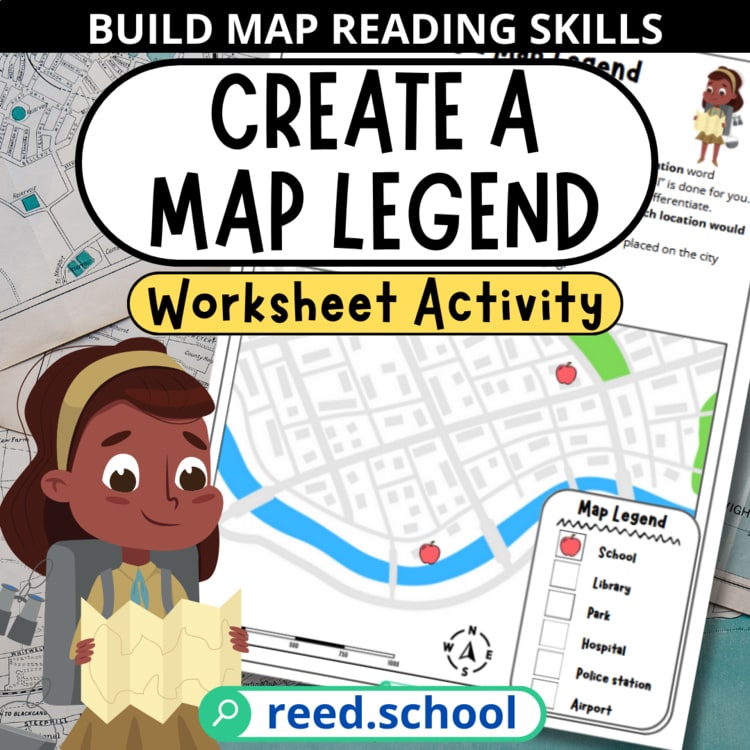
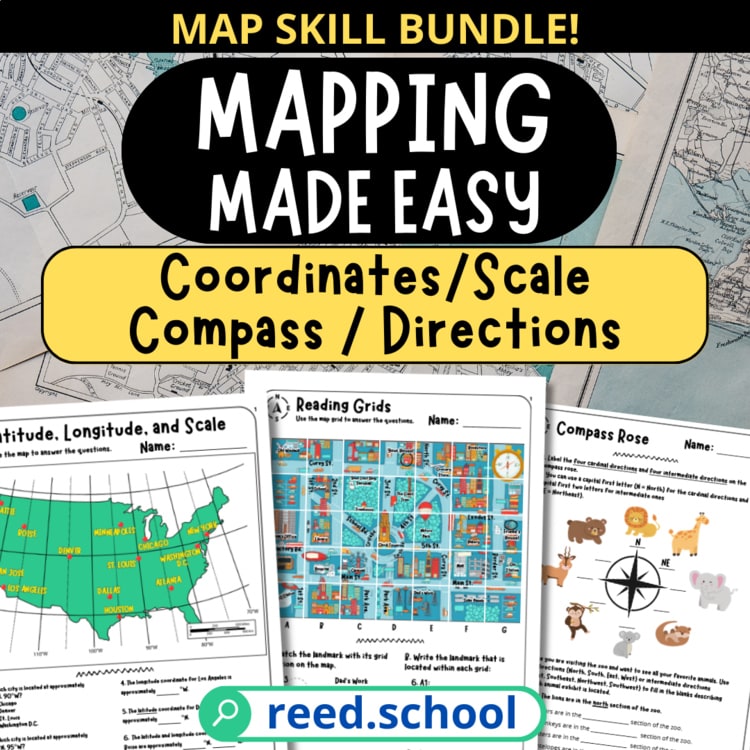
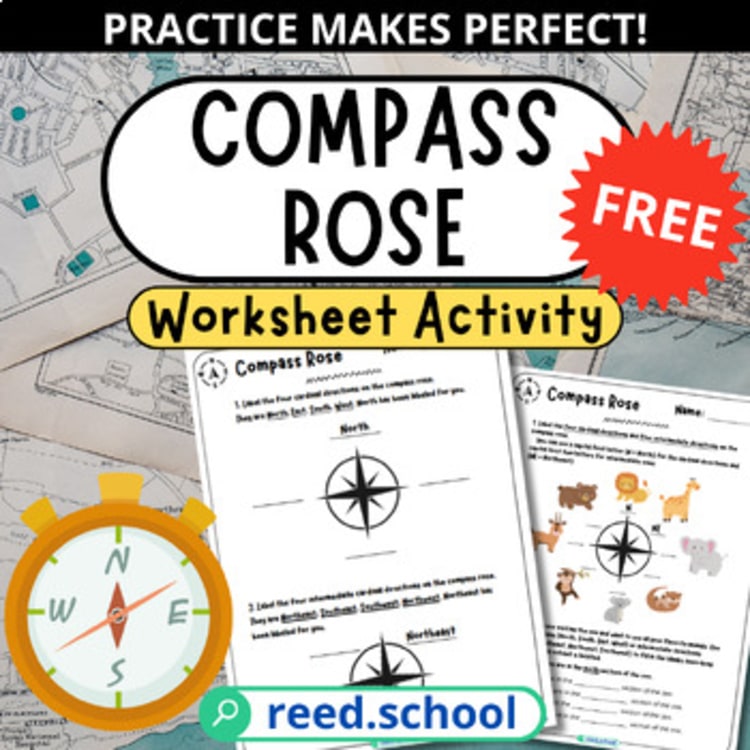
The free Compass Rose Practice provides a short set of scaffolded pages for cardinal and intermediate directions. When students are ready to combine direction with symbols, scale, coordinates, and legends, the Mapping Made Easy collection provides a connected next step.