Many students can write a topic sentence and add two facts. The paragraph still feels unfinished because the reader has to make the connection alone.
The missing layer is explanation: the writer’s reasoning about how the evidence supports the point. Teaching that layer explicitly helps students write paragraphs that develop an idea rather than stack information.
Use a three-part model
Keep the language simple:
- Point: What do I want the reader to understand?
- Evidence: What fact, example, detail, or quotation supports it?
- Explanation: How does the evidence prove, illustrate, or develop the point?
For younger writers, “point” may be called a topic sentence or claim. The labels matter less than the relationships.
Example:
Point: Recess can help students return to class ready to learn.
Evidence: During recess, students can move, talk, and take a break from seated work.
Explanation: This change of activity can release energy and give students a mental reset before the next lesson.
The explanation does not repeat the evidence. It interprets it.
Model the invisible thinking
Writers often skip explanation because the connection feels obvious in their own minds. Think aloud:
I know movement happens at recess, but my reader needs to know why that detail supports readiness to learn. I will explain the effect of movement and a break on returning to class.
Use a deliberately weak example:
School gardens are useful. Students can grow vegetables. Gardens are useful.
Ask what the writer expects the reader to infer. Then add the missing reasoning:
Growing vegetables lets students observe plant life cycles and connect science vocabulary with a real process.
Teach useful explanation questions
After each piece of evidence, students can ask:
- Why does this detail matter?
- What does it show?
- How does it support my point?
- What can the reader understand because of it?
- What is the result or consequence?
- Which word in the evidence is most important?
- What might a reader misunderstand without my explanation?
Post two or three questions at a time. A long list can become another worksheet instead of a thinking tool.
Use color to reveal the structure
Color-code one model paragraph:
- Point in blue
- Evidence in green
- Explanation in orange
Then ask students to mark a second paragraph. If a section has only blue and green, the missing orange becomes visible.
Color is temporary support. Students should eventually identify the relationships without depending on markers.
Begin orally
Some students can explain an idea in conversation before they can write it. Use a partner routine:
- Student reads the point and evidence.
- Partner asks, “So what does that show?”
- Student answers aloud.
- Student turns the oral answer into a sentence.
Record one class example in which the spoken explanation is informal, then revise it into clear written language.
Distinguish explanation from repetition
Evidence:
The character returns the lost wallet even though no one is watching.
Repetition:
This shows the character returns the wallet.
Explanation:
This action suggests the character values honesty for its own sake, not only because an adult might reward it.
Ask students to cover the evidence sentence. If the explanation simply restates it with “This shows,” more reasoning is needed.
Use sentence frames as a bridge
Helpful frames include:
- This matters because…
- This shows that…
- As a result…
- The example supports the point by…
- Readers can infer…
- This detail is important because…
- Without ___, ___ would…
Require students to complete the thought. “This shows that it is important” remains vague.
As writers gain confidence, remove the frame and encourage varied sentence openings.
Choose evidence before writing the whole paragraph
Give students a point and three possible details. Ask them to rank the evidence from strongest to weakest.
Then discuss:
- Which detail is most directly connected?
- Which detail is true but not useful?
- Which detail needs background explanation?
- Could two details work together?
Better evidence makes explanation easier.
Add a second evidence-explanation pair carefully
Developing writers may benefit from this pattern:
- Point
- Evidence
- Explanation
- Additional evidence
- Additional explanation
- Concluding insight
Do not require exactly two details forever. The purpose is to practice development. Some ideas need one deeply explained example; others need several pieces of evidence.
Revise by asking where the reader has to jump
Read the paragraph sentence by sentence. Between each pair, ask:
What connection is the reader expected to make?
If the jump is too large, add explanation, transition, or context. If two sentences make the same point, combine or remove one.
A useful revision mark is an arrow drawn from evidence to the point. Students write the explanation along the arrow.
Assess one paragraph with three questions
Instead of a long rubric, ask:
- Is the point specific?
- Is the evidence relevant?
- Does the explanation show why the evidence matters?
Give feedback on the weakest link. A writer with strong evidence but vague explanation needs a different next step from a writer whose evidence does not fit.
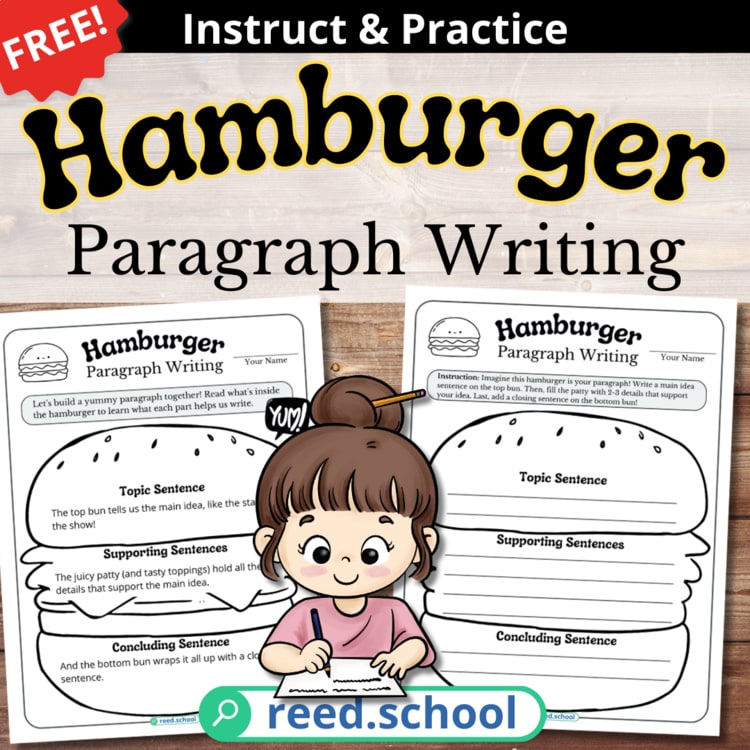
The Hamburger Paragraph Organizer provides a visual structure for topic sentence, supporting details, explanation, and conclusion. Pair it with the Hamburger Paragraph Method guide when introducing the full scaffold.