National days can give a classroom an endless supply of quick topics: foods, inventions, hobbies, animals, public causes, and historical anniversaries. The novelty helps students begin, but the date itself is not the learning goal.
A strong prompt turns the observance into a reason to argue, explain, imagine, compare, or reflect.
Verify the observance before using it
Many “national days” are informal promotions rather than official public holidays. That does not make them unusable, but teachers should describe them accurately.
Before presenting one as fact, check:
- Who created or promotes the observance?
- Is it official, commemorative, commercial, or simply popular online?
- Does the date vary by source?
- Is the topic connected to a sensitive event or community?
- Is the background information current?
Use wording such as “Today is often promoted as…” when the status is informal.
Match the day with a writing purpose
Argument
- Should schools recognize this day? Why or why not?
- Which of three related ideas deserves a day of its own?
- Is awareness-day publicity an effective way to create change?
Explanation
- Explain how the object, food, or practice works.
- Describe why the topic matters to a particular group.
- Explain the steps needed to create or protect it.
Narrative
- Write a scene in which the day’s topic creates a problem.
- Tell the story from the point of view of an object being celebrated.
- Imagine the observance fifty years in the future.
Description
- Describe the topic using four senses without naming it.
- Create a museum label for an ordinary object.
- Write precise directions for someone who has never encountered it.
Comparison
- Compare two versions, uses, habitats, or traditions.
- Decide which of two inventions had a larger effect.
- Compare the way two communities recognize a similar idea.
Students begin faster when they know the writing job.
Add one constraint that sharpens thinking
A small constraint can prevent a vague response:
- Use one fact and one opinion.
- Include a counterargument.
- Write exactly six sentences.
- Use two domain-specific words.
- Address a named audience.
- Begin with a question but do not end with one.
- Include one comparison.
- Avoid the words “good,” “bad,” and “fun.”
The constraint should serve the lesson, not become a gimmick of its own.
Provide enough context to be fair
A prompt should not reward only students who already know the topic. Give a short, neutral introduction: one image, two facts, or a brief definition.
Then ask students to use the supplied information. For example:
Today is associated with protecting pollinators. Bees and other pollinators help many flowering plants reproduce. Design one realistic change a school could make and explain how it could help.
Every student now has a starting point.
Turn trivia into evidence
If the prompt includes a surprising fact, make students do something with it.
Instead of:
What is your favorite kind of bridge?
Try:
Engineers choose bridge designs based on distance, load, materials, and geography. Which factor should be considered first in a flood-prone area, and why?
Instead of:
Do you like chocolate?
Try:
A product can connect farming, trade, manufacturing, advertising, and culture. Which part of the supply chain would you investigate first to understand chocolate’s impact?
The novelty opens the door; the question creates the thinking.
Use audience to improve writing
Ask students to write for someone specific:
- A younger student
- A school principal
- A museum visitor
- A skeptical classmate
- A city council
- A future reader
- A customer
- A scientist or historian
Audience changes vocabulary, detail, tone, and explanation. It also makes revision easier: “Would this reader understand what you mean?”
Build a discussion bridge
After writing, use a short structure:
- Students underline the sentence they most want to share.
- Partners read only that sentence first.
- The partner asks one question.
- The writer adds or revises one sentence.
This keeps discussion connected to writing and gives every student a reason to revisit the response.
Handle culturally specific days with care
Some observances have religious, ethnic, national, political, or personal significance. Do not reduce them to costumes, foods, or “fun facts.”
When a day represents a community:
- Use reliable sources created with or by that community.
- Avoid asking one student to represent an entire group.
- Distinguish celebration from study.
- Provide historical and contemporary context.
- Avoid simulations of oppression or sacred practices.
- Invite respectful questions without requiring personal disclosure.
A different neutral prompt should be available when participation would create discomfort.
Create a balanced monthly mix
If every prompt asks for personal opinion, writing becomes repetitive. Across a month, include:
- Argument
- Explanation
- Narrative
- Description
- Comparison
- Revision
- Vocabulary
- Source evaluation
- Visual interpretation
- Reflection
Also vary the scale: one day can be playful and small, while another addresses a meaningful public issue.
Use a no-grade response system
These prompts work well as bell ringers when students keep one notebook or weekly response page. Choose one entry for teacher feedback, one for peer response, and one for student revision.
The Bell Ringers Without the Grading Pile guide offers a complete routine for keeping daily writing sustainable.
End with one transfer question
After several weeks, ask:
Which prompt type helped you produce your clearest thinking, and what did you do as a writer?
Students may notice that a named audience, a comparison, or an evidence requirement helped them move beyond the first idea.
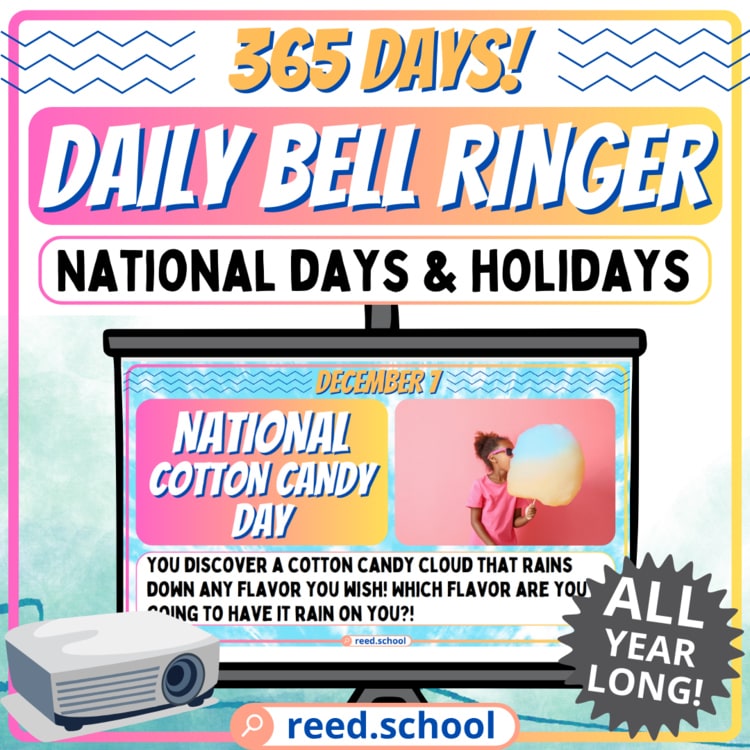
The 365 Daily Bell Ringers provide projectable prompts connected to national days and holidays throughout the year. Use them as starting points, then choose the writing purpose and feedback routine that match your class.