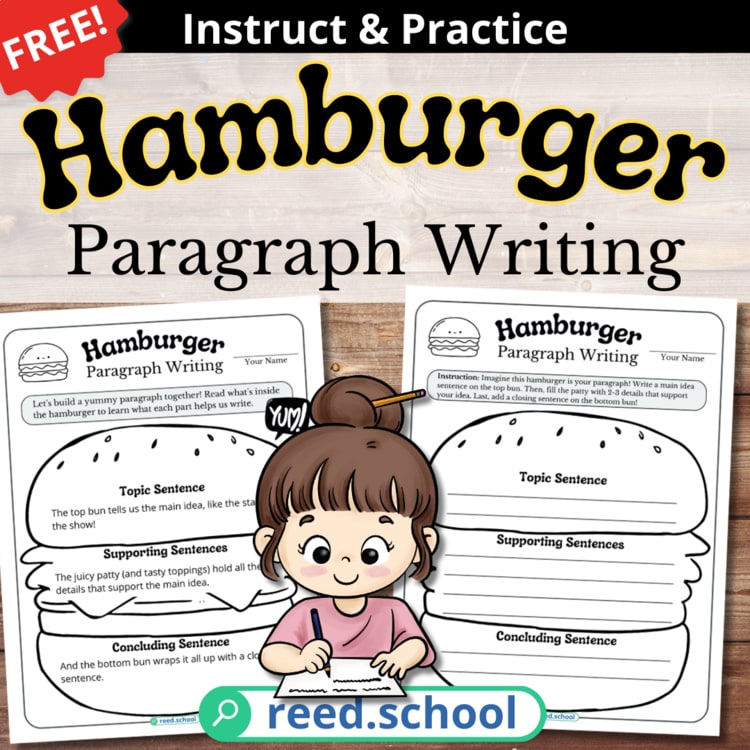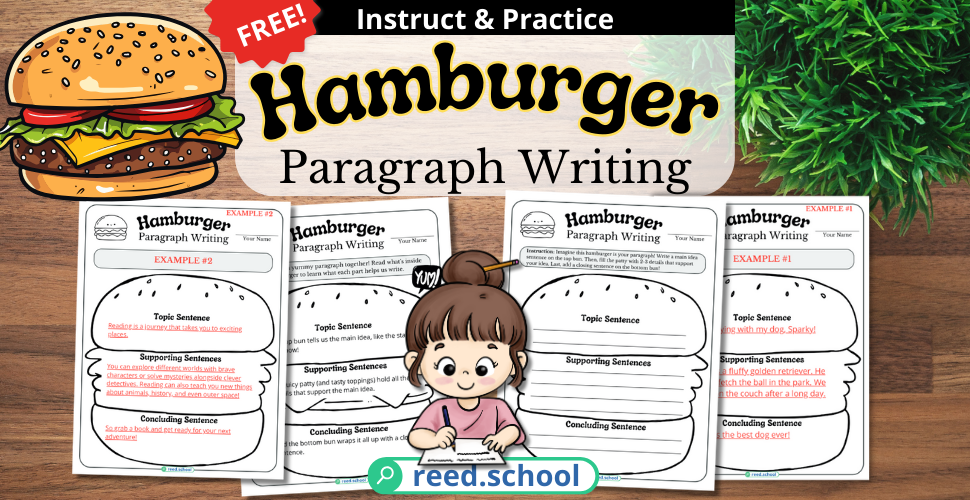
The hamburger paragraph method gives developing writers a picture they can hold in their minds: a paragraph has an opening that contains the idea, a middle that develops it, and an ending that brings the reader back to the point.
It is most useful as a scaffold, not a permanent formula. Once students can build a complete paragraph consistently, the visual can fade and their writing can become more flexible.
Explain what each layer does
Keep the food analogy tied to a writing job:
- Top bun — topic sentence: Introduces the paragraph’s main point.
- Fillings — supporting details: Add evidence, examples, facts, or reasons.
- “Sauce” — explanation: Shows how each detail supports the main point.
- Bottom bun — concluding sentence: Brings the paragraph to a satisfying close.
The explanation layer matters. Without it, students often produce a stack of unrelated facts rather than a developed paragraph.
Model the thinking before the template
Start with a prompt students can answer from experience:
What makes recess valuable?
Think aloud as you plan:
- Main point: Recess helps students return to class ready to learn.
- Detail: Movement releases energy.
- Explanation: Students may be better able to focus after active play.
- Detail: Games provide social practice.
- Explanation: Students learn to cooperate and solve small conflicts.
- Conclusion: Recess supports both attention and relationships.
Then show where each idea belongs on the organizer. Students should see that the picture represents thinking that has already begun; it does not generate ideas by itself.
Move from shared writing to independence
Use a gradual release:
- Build one together. The class suggests ideas while you ask what belongs and why.
- Plan in pairs. Partners talk through a prompt and complete one organizer.
- Draft independently. Each student turns a plan into connected sentences.
- Revise without the picture. Students reread for meaning, flow, and variety.
During the first round, color-coding can help: one color for the main idea, another for evidence, and a third for explanation.
Teach transitions as relationships
Transition words are not decorations. Ask students to choose them based on the relationship between ideas:
- Adding: also, in addition, another
- Giving an example: for example, for instance
- Showing cause: because, therefore, as a result
- Contrasting: however, although, on the other hand
If every detail begins with “First,” “Next,” and “Finally,” the paragraph may sound like directions even when it is explaining an idea.
Differentiate the organizer
Use the lightest support that lets each writer succeed.
- Give sentence stems to students who need help beginning.
- Let students sketch each detail before writing.
- Reduce the number of supporting details while keeping an explanation.
- Allow speech-to-text or oral rehearsal before drafting.
- Add an extra evidence-and-explanation layer for students ready to elaborate.
- Ask advanced writers to vary sentence openings or build a paragraph without an explicit concluding restatement.
Multilingual learners may benefit from discussing the content in their home language before choosing English words for the draft.
Troubleshoot common problems
The topic sentence is too broad
“Dogs are interesting” gives the paragraph nowhere specific to go. Ask, “What exactly do you want the reader to understand about dogs?”
Details do not support the point
Have students finish the sentence “This matters because…” after each detail. If they cannot connect it to the main idea, the detail may belong elsewhere.
The conclusion only repeats
Encourage students to answer “So what?” A conclusion can explain the importance of the point, suggest a next step, or leave the reader with a final insight.
The draft sounds like a list
Add explanation between details, combine short sentences, and choose transitions that show relationships.
Help students outgrow the hamburger
After several successful paragraphs, remove one support at a time. Replace the illustrated organizer with a plain outline, then with a short checklist:
- Is the main point clear?
- Does every detail belong?
- Have I explained my evidence?
- Does the ending feel earned?
Show students published paragraphs that do not have exactly three details or a restated conclusion. The method teaches the logic of a paragraph; strong writers eventually adapt that logic to their purpose.
Try the organizer
The Hamburger Paragraph Writing Template and Graphic Organizer is free to preview on Reed.School. You can also get the original download on TPT.