Bell ringers can settle a class, activate prior knowledge, and give every student an immediate way into the lesson. They can also create hundreds of tiny papers that no teacher has time to grade.
The solution is to separate practice from evaluation. Students should know that the opening task matters, but “matters” does not have to mean “receives a score every day.”
Give the routine one clear job
A bell ringer becomes easier to manage when its purpose is visible. Common purposes include:
- Retrieve yesterday’s learning
- Preview today’s topic
- Practice one writing move
- Generate a question
- Build vocabulary
- Start a low-stakes discussion
- Create a calm transition into class
Avoid using one prompt to accomplish everything at once. A five-minute task should have one main outcome.
Keep the time boundary real
Design prompts that can be completed in five to ten minutes, including review. If students regularly need fifteen minutes, the task is no longer a bell ringer.
A dependable routine might be:
- One minute: Read and think.
- Three minutes: Write.
- Two minutes: Compare or discuss.
- Two minutes: Review one response or connect to the lesson.
Display a timer and stop when time ends. Students learn that the goal is a focused first response, not a polished essay.
Use a small set of response formats
Familiar formats reduce directions. Rotate among four or five:
- One claim and one reason
- Three-sentence quickwrite
- Rank three options and explain the top choice
- Notice, wonder, predict
- Correct the error
- Choose the strongest evidence
- Complete a before-and-after revision
- Sketch and label
Students can spend their attention on the idea instead of decoding a new worksheet structure.
Decide what receives feedback
Use a weekly feedback plan rather than daily grading.
Sample one day
Tell students that one bell ringer each week will receive a brief teacher check. The day may be announced or selected after completion, depending on your classroom expectations.
Collect one best response
At the end of the week, students choose the response that best shows their thinking, revise it, and submit only that one.
Use rotating groups
Read responses from one table or class group each day. Over a week or two, everyone receives attention.
Check one criterion
Instead of scoring the entire response, look for one feature: a complete claim, relevant evidence, precise vocabulary, or explanation.
Confer through circulation
While students write, scan work and ask one short question. A checkmark, underline, or verbal prompt may be enough.
The method should match the purpose. Retrieval practice may need correction; a discussion starter may need acknowledgment rather than a score.
Make completion visible without making it punitive
Students need accountability, but a complex point system can consume more time than the routine saves.
Simple options:
- Date each entry in one notebook.
- Use a weekly page with five boxes.
- Ask students to highlight the day’s key sentence.
- Conduct a quick visual check while circulating.
- Use an occasional open-notebook reflection.
- Let students submit one photographed page at the end of the week.
If a student is absent, avoid requiring a pile of disconnected make-up prompts. Mark the absence and continue the routine.
Build discussion into the design
A quick pair share gives the writing an audience. Provide a specific exchange:
- Read your claim. Your partner asks, “Why?”
- Compare rankings and identify one disagreement.
- Share one word you used precisely.
- Find one similarity and one difference.
- Choose one response the pair wants the class to hear.
“Turn and talk” works better when students know what to do with the talk.
Use national days and novelty carefully
A curious daily theme can make the opening feel fresh, but the prompt still needs substance. Connect novelty to a thinking move:
- Make a case for or against celebrating the day.
- Design a fair rule connected to the topic.
- Compare the theme with a historical or literary example.
- Explain which audience would care most.
- Write a six-word advertisement and justify one word choice.
A prompt about an unusual food, invention, animal, or tradition can become writing practice instead of trivia.
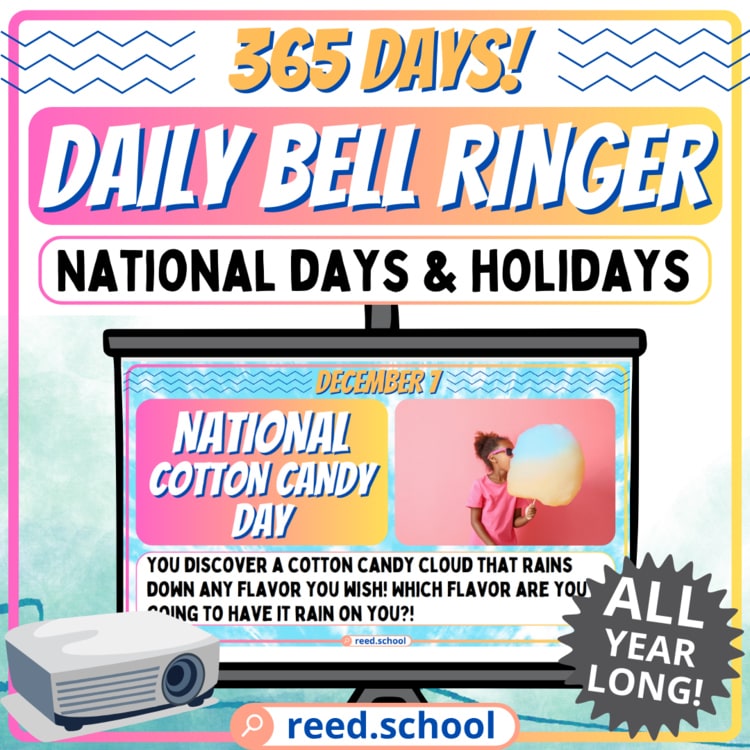
The 365 Daily Bell Ringers provide a full year of projectable national-day and holiday prompts that can fit this kind of routine.
Respond to weak effort without grading everything
When a student repeatedly writes one vague sentence, do not add a full rubric. Use one of these moves:
- Ask for a minimum number of specific details.
- Require the student to underline the reason or evidence.
- Provide a sentence frame temporarily.
- Have the student revise one entry during independent work.
- Compare a vague and specific example.
- Hold a brief conference about the purpose of the routine.
The goal is better participation, not a larger punishment system.
Use bell ringers as formative information
Look for patterns:
- Which concept is widely misunderstood?
- Which vocabulary word is not yet secure?
- Who can answer accurately but cannot explain?
- Which students need more time before public discussion?
- What question is the class ready to explore?
Respond by adjusting the lesson. A bell ringer is most valuable when it changes what happens next.
Close the loop once a week
At the end of the week, ask students to review their entries and complete one reflection:
- Which response changed your thinking?
- Which answer would you improve now?
- What idea appeared more than once?
- Which prompt produced your strongest evidence?
- What writing habit helped you begin quickly?
This gives the notebook coherence without grading every line.
A sustainable bell-ringer system produces more thinking than paperwork. Choose one purpose, one short routine, and one realistic feedback method. Consistency will do more than a daily score.