Time zones combine geography, elapsed time, direction, and changing conventions. Students can perform the arithmetic correctly and still move the clock the wrong way.
The best starting point is not a list of zone names. It is the relationship between Earth’s rotation and local time: different longitudes face the Sun at different times, so noon cannot occur everywhere at once.
Model day and night first
Use a globe and a lamp. The lamp represents the Sun; the globe rotates from west to east. Mark several locations with sticky notes and observe when each one moves into light, toward the most direct light, and into darkness.
Keep the explanation age appropriate:
- Earth rotates once in about 24 hours.
- As Earth turns, different places experience daytime at different times.
- Time zones create shared clock times across broad regions so every town does not keep a completely separate solar time.
Students do not need a detailed history of standard time before they understand the basic geographic problem.
Use a horizontal number line
Place time zones from west to east on a number line. For a simplified U.S. example:
Pacific — Mountain — Central — Eastern
Teach one dependable rule:
- Travel east on the map: the clock usually moves later.
- Travel west on the map: the clock usually moves earlier.
Connect the direction to sunrise. Places farther east generally encounter a new day earlier than places farther west.
Have students trace the direction with a finger before changing the time.
Separate direction from arithmetic
Use a three-step routine:
- Identify the starting time zone.
- Count the zone boundaries to the destination.
- Decide whether to add or subtract based on east or west.
Example:
It is 2:00 p.m. in the Pacific zone. What time is it in the Eastern zone?
There are three zone steps east, so add three hours: 5:00 p.m.
Ask students to write the direction word and operation before solving:
east → later → add
This prevents the operation from becoming a guess.
Practice with clocks before word problems
Give students two labeled clocks and a zone map. Set one clock, then ask them to adjust the other. Physical or paper clocks make crossing noon and midnight more visible.
Progress in this order:
- Whole-hour differences without crossing noon
- Problems that cross noon
- Problems that cross midnight
- Multi-step travel or scheduling problems
- World-zone problems using UTC offsets
Do not introduce every complication in the first lesson.
Explain UTC as a reference point
Coordinated Universal Time, or UTC, gives the world a common reference. Locations are described as a number of hours ahead of or behind UTC.
A simple number line works again:
UTC−5, UTC−4, UTC, UTC+1, UTC+2
Students can compare offsets by counting the distance between them. For example, a location at UTC+2 is seven hours ahead of a location at UTC−5.
Make clear that an offset is not a permanent description of every local clock. Daylight saving rules and political decisions can change local offsets.
Treat daylight saving time as a convention
Daylight saving time is not caused by Earth rotating differently. It is a clock convention adopted in some places and not others.
For an elementary lesson, students should understand:
- Some regions move clocks forward for part of the year.
- Not every place follows the same rule.
- Start and end dates may differ by country or region.
- A current schedule or reliable time-zone source should be checked for real travel planning.
Avoid asking students to memorize a long list of exceptions. The durable skill is knowing that time-zone calculations sometimes require current information.
Use meaningful scheduling problems
Time zones become useful when students coordinate an event:
- A video call between two classrooms
- A live sports broadcast
- A flight departure and arrival
- A scientist sharing data with a partner overseas
- A family calling relatives in another region
Ask students to consider whether the destination time is practical, not merely compute it.
A class in New York wants to call a class in California at 1:00 p.m. Eastern. What time will it be in California? Would both classes probably be in school?
The second question gives the calculation a purpose.
Address common errors
Adding when traveling west
Students may associate “forward” with travel rather than time. Return to the map direction: east is generally later; west is generally earlier.
Forgetting a date change
When a calculation crosses midnight, require students to write “previous day” or “next day.” Use a 24-hour timeline when needed.
Assuming every zone is exactly one hour wide
Many school maps simplify time zones. Real boundaries bend around political borders, and some places use half-hour or quarter-hour offsets. Present the classroom model as a useful simplification, not a perfect grid.
Treating noon as 12:00 a.m.
Review that noon is 12:00 p.m. and midnight is 12:00 a.m. A labeled timeline can reduce this recurring confusion.
Assess with one calculation and one explanation
A useful exit ticket asks students to:
- Calculate a time difference between two zones.
- Explain why they added or subtracted.
- State whether the date changed.
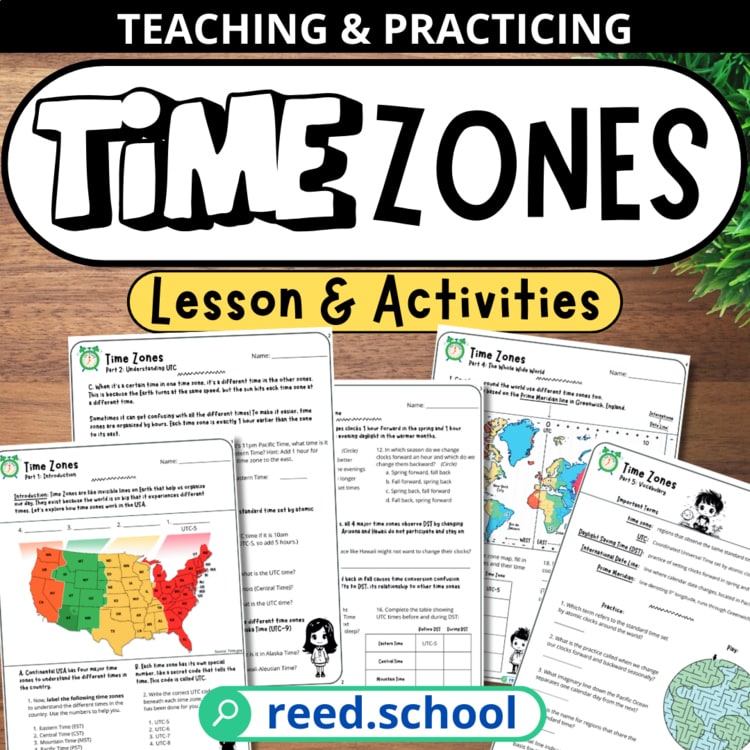
The Time Zones, UTC & Daylight Saving Time lesson includes visual explanations and practice with both U.S. and world time zones. It works best after students can use the east-later, west-earlier routine consistently.