A successful novel study protects the experience of reading the story. If every chapter is followed by a long worksheet, students can begin to see the book as a source of questions rather than a complete work of literature.
For Matilda, a balanced plan combines reading, short comprehension checks, discussion, vocabulary, and occasional creative work. The exact pace depends on whether the novel is read aloud, independently, in groups, or through a combination.
Decide how students will access the text
Choose the reading model before planning assignments.
Read-aloud model
The teacher reads most or all of the novel. This supports shared pacing, fluency modeling, and access for students who may not yet read the book independently.
Independent model
Students read assigned sections on their own. This works when decoding demands are appropriate and students have reliable access to the book.
Blended model
The teacher reads important or demanding sections aloud while students read other sections independently or with partners. This often provides the best balance in grades 3–5.
Audiobooks may support access when licensing and school policies allow, but students should still interact with the print or digital text when the lesson requires locating evidence.
Group chapters by purpose
Do not assume every chapter needs a separate assignment. Group chapters around a meaningful development:
- Introduction of a character or setting
- A shift in conflict
- A revealing pattern of behavior
- A turning point
- A consequence
- A change in a relationship
- Movement toward resolution
A short chapter may require only an oral recap. A major turning point may deserve rereading and discussion.
Use a predictable weekly rhythm
A four-week structure might follow this pattern:
Monday: Launch and vocabulary
Preview two or three words that are essential for understanding. Introduce the week’s discussion question without revealing later events.
Tuesday: Read and notice
Students record one important event, one character choice, and one question.
Wednesday: Discuss and reread
Return to a short section that reveals character, conflict, or tone. Students support an interpretation with evidence.
Thursday: Respond or create
Use a concise written response, character diary, illustration with annotation, comparison, or dramatic reading.
Friday: Synthesize
Students explain how the week’s events changed a character, conflict, or theme. Include a short retrieval review from earlier chapters.
The rhythm reduces directions and makes room for actual reading.
Keep vocabulary connected to the passage
Select words that matter to the scene or recur across the novel. Avoid assigning a long dictionary list before students encounter the language.
Use this routine:
- Read the sentence in context.
- Identify clues in the sentence or nearby text.
- Propose a meaning.
- Confirm with a glossary or dictionary.
- Reuse the word in a new sentence.
Roald Dahl’s playful language can also support word-consciousness. Students can notice sound, exaggeration, unusual comparisons, and invented or unexpected expressions without copying long passages.
Balance comprehension levels
A strong chapter set includes a small number of questions at different levels.
Literal
What happened? Who was present? What problem appeared?
Inferential
What does the action suggest about the character? Why might the character respond this way?
Analytical
How does the author create humor, tension, sympathy, or contrast? How does this scene develop a larger idea?
Evaluative or creative
Was the response effective? What alternative might the character have chosen? How would the scene change from another point of view?
Students do not need ten questions at every level. Two or three purposeful questions are often enough.
Track character through evidence
Give students a character chart with three columns:
| Action or words | What this suggests | Has the pattern changed? |
|---|
Require a specific event or brief reference rather than a trait alone. “Clever” becomes meaningful when students explain which decision demonstrates cleverness and what result follows.
Include more than the title character. Comparing how adults and children use power can open a productive theme discussion.
Discuss difficult behavior thoughtfully
The novel contains exaggerated cruelty, neglect, humiliation, and revenge presented through dark humor. Set clear discussion norms:
- We can analyze a character’s actions without imitating them.
- Humor does not automatically make harm acceptable.
- Readers may react differently to the same scene.
- We support interpretations with evidence.
- Students may pass on personal disclosure.
Keep the focus on the text rather than inviting students to compare fictional mistreatment with private family experiences.
Use creative responses that require reading
Creative work is strongest when it depends on evidence. Options include:
- Design a school rule and explain which event inspired it.
- Create a character report card with evidence for each rating.
- Rewrite a short event from another character’s perspective.
- Make a cause-and-effect comic strip.
- Create a book cover and justify three design choices.
- Write advice to a character at a turning point.
Require a brief annotation or explanation so the activity does not become disconnected art time.
Plan for absent students
Novel studies can become difficult to reenter after an absence. Maintain a chapter log with:
- Chapters covered
- Three-sentence recap
- Key vocabulary
- Major question
- Assignment due
This helps absent students catch up without receiving a substitute for reading the entire novel.
Assess the whole-book understanding
A final task should ask students to connect several parts of the novel. Possibilities include:
- Trace how a character changes or remains consistent.
- Explain how power is used by two characters.
- Develop a theme and support it with evidence from the beginning, middle, and end.
- Compare two settings and their effect on characters.
- Evaluate one major choice and its consequences.
Provide response choices while keeping the evidence expectation common.
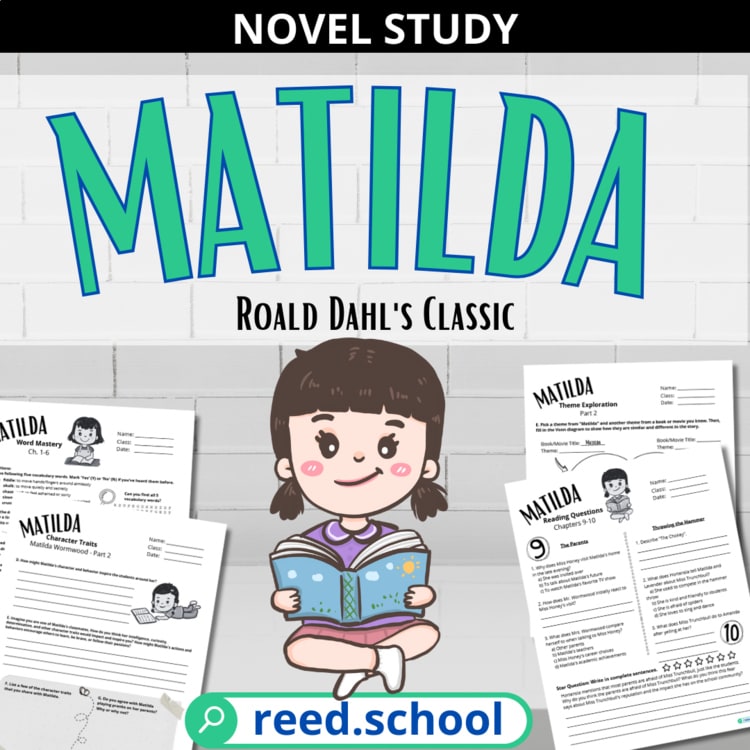
The Matilda Novel Study includes chapter-based comprehension, vocabulary, critical-thinking, and creative-writing activities. Use the materials selectively within a reading-first rhythm rather than assigning every page automatically.