Aesop’s fables are useful for teaching theme because they are short, memorable, and built around a clear relationship between choice and consequence. Their brevity lets students reread the whole text while testing an interpretation.
The challenge is preventing the lesson from becoming “guess the teacher’s moral.” Students should learn to build a theme statement from evidence and recognize that readers may phrase the lesson differently.
Separate topic, theme, and moral
Use three levels:
- Topic: a broad subject, often one or two words, such as patience, pride, honesty, or cooperation
- Theme: a complete idea the text suggests about that topic
- Moral: an explicitly stated or strongly implied lesson about how people should act
For The Hare and the Tortoise:
- Topic: persistence
- Theme statement: Steady effort can overcome a stronger opponent who becomes careless.
- Moral phrasing: Do not underestimate consistent effort or become overconfident.
Students may produce another defensible statement if it fits the events.
Begin with choices and consequences
Before asking for theme, chart what the characters do.
| Character choice | Immediate result | Later consequence |
|---|---|---|
Then ask:
- Which choice mattered most?
- What belief seems to guide the character?
- What changes because of the choice?
- What might a reader learn from that pattern?
Theme grows from the pattern. It should not appear as a disconnected slogan.
Use a “because” test
Require students to complete:
The story suggests ___ because ___.
The second half must name an event, character action, or consequence.
A weak response:
The theme is kindness because kindness is important.
A stronger response:
The story suggests that kindness can be repaid because the smaller character later helps the stronger one when help is needed.
The evidence makes the interpretation visible.
For short browser-based practice, Fable Detective asks students to connect a character’s choice with its consequence, choose the best-supported moral, and file evidence from an original retelling.
Let students revise overly broad morals
Students often write statements such as “Be good” or “Never give up.” Ask questions that add precision:
- In what situation?
- What behavior does the story reward or criticize?
- Is “always” really supported?
- What consequence makes the lesson clear?
- Could the statement apply to almost any story?
A strong theme statement is broad enough to transfer beyond the fable but specific enough to reflect this story.
Compare two fables with a shared topic
Choose two fables that both involve pride, trust, work, patience, or cooperation. Ask whether they make the same point.
For example, two stories may address cleverness, but one warns against deception while another celebrates problem solving. Students can complete:
Both stories involve ___. However, the first suggests ___, while the second suggests ___.
Comparison helps students see that a topic does not determine one universal theme.
Use character perspective
Ask students to retell the lesson from another character’s point of view:
- What would the character say was learned?
- Would every character agree?
- Which character changes, and which one does not?
- Does the narrator’s moral match the character’s understanding?
This opens room for nuance. A character may suffer a consequence without fully learning from it.
Discuss whether the moral is fair
Fables simplify life to make a point. Invite students to test the lesson:
- When might the moral be helpful?
- When might it need an exception?
- What information does the short story leave out?
- Would the outcome be different in real life?
This does not weaken the lesson. It teaches students to interpret rather than obey a slogan automatically.
Support mixed-level readers
Because the stories are short, the whole class can work with the same fable at different levels of text complexity.
Keep the intellectual task shared:
- Identify the crucial choice.
- Explain the consequence.
- Propose a moral.
- Cite evidence.
- Compare interpretations.
Students who need support can use a vocabulary preview, audio, sentence frames, or a more accessible version. Students ready for extension can analyze irony, narrator language, or competing morals.
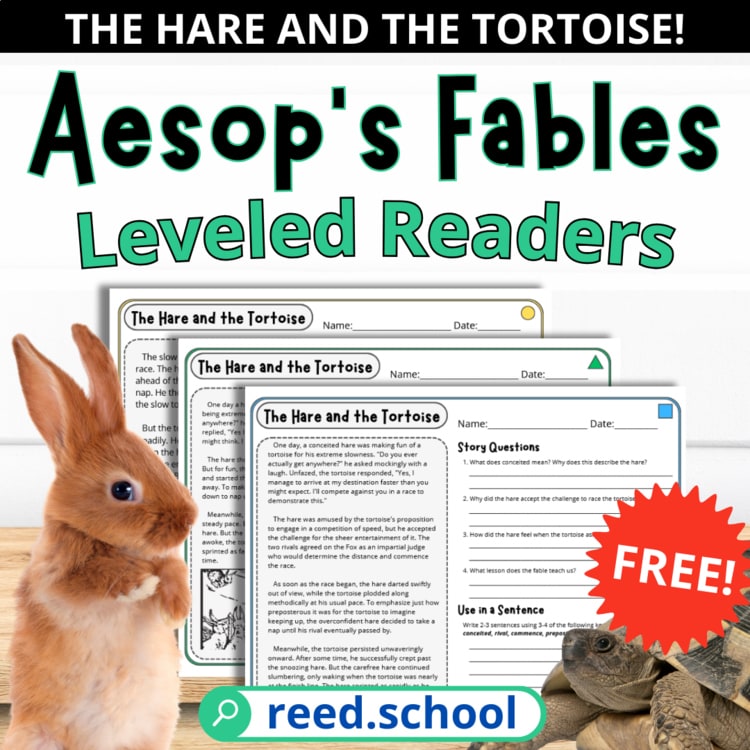
The free Hare & Tortoise leveled sample lets students read one familiar fable at three levels while answering common comprehension questions.
Move from supplied morals to student-generated ones
A useful progression:
- Match a fable with two possible morals.
- Choose the stronger moral and explain why.
- Revise a vague moral.
- Write a moral from a choice-and-consequence chart.
- Compare two defensible morals for the same story.
- Apply the theme to a new situation.
Do not show the traditional moral first when the goal is inference. Let students build and defend an interpretation, then compare it with a published version.
Use a concise written response
A strong paragraph can follow this structure:
- State the theme or moral.
- Name the character choice that begins the pattern.
- Explain the consequence.
- Connect the evidence to the lesson.
For developing writers, use the frame:
One lesson in the fable is ___. At first, ___. Because of this, ___. This shows ___ because ___.
End with transfer
Give students a new scenario rather than another fable:
A student rushes through a project because the work feels easy, while a classmate follows the directions carefully over several days.
Ask which fable theme may apply and where the analogy breaks down. Transfer demonstrates that students understand the idea beyond the original plot.
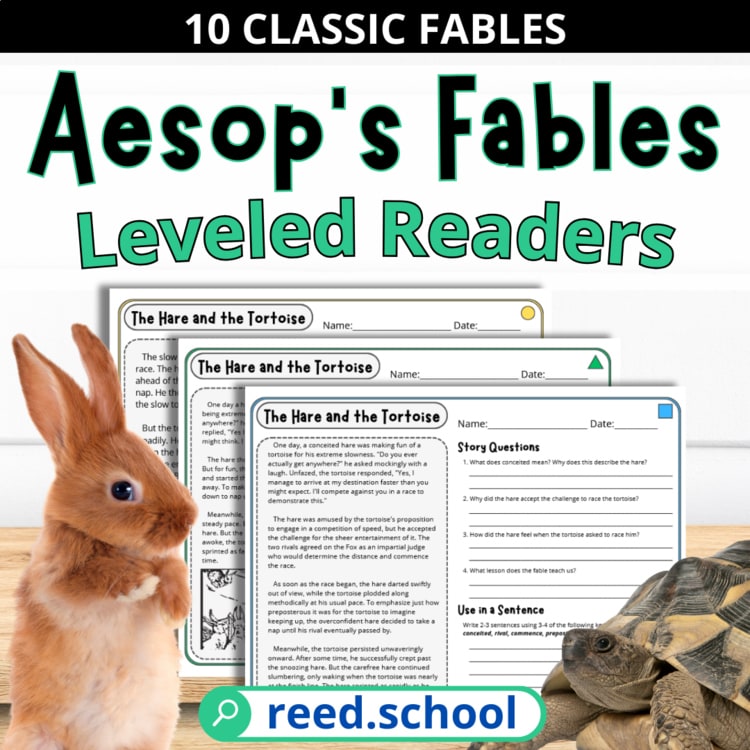
The Aesop’s Fables Leveled Readers include ten classic stories at three reading levels, making it possible to teach theme through a shared class conversation without giving every reader identical text complexity.