A long list of questions does not automatically produce close reading. Ten low-value items can pull students away from the text, while three carefully sequenced questions can reveal what they understand and how they reason.
The best comprehension questions are answerable from the text, connected to the lesson purpose, and clear about the kind of thinking required.
Begin with the reason for reading
Before writing questions, finish this sentence:
After reading, students should understand that…
For a narrative, the goal may involve character motivation, cause and effect, point of view, or theme. For informational text, it may involve central idea, evidence, sequence, comparison, or explanation.
Every question should help students build or demonstrate that understanding. Remove questions included only because a minor detail is easy to test.
Use a purposeful sequence
A useful progression includes four levels.
1. Establish the text
Ask one question that confirms students understand the essential situation or idea.
What problem does the character face at the beginning?
What process is the passage explaining?
2. Examine a relationship
Ask students to connect events, ideas, or details.
How does the first decision affect what happens next?
What relationship does the author show between rainfall and vegetation?
3. Infer or analyze
Require students to use evidence to explain something not stated in one sentence.
What does the response suggest about the character’s priorities?
Why did the author include the second example?
4. Synthesize or transfer
Ask students to develop a larger idea or apply the reasoning.
What theme emerges from the pattern of choices and consequences?
Which solution would best address the problem described, and why?
Not every short passage needs all four levels, but the sequence should move somewhere.
Make questions text-dependent
A text-dependent question cannot be answered well without reading.
Weak:
Have you ever been impatient?
Stronger:
Which action shows the character becoming impatient, and what consequence follows?
Personal connections can support engagement, but they should follow comprehension rather than replace it.
Check answerability
Before assigning a question, answer it yourself using the exact version students will read. Identify the evidence location.
Ask:
- Is enough information present?
- Is the wording age appropriate?
- Does the question accidentally require outside knowledge?
- Could two answers be reasonable?
- If so, does the prompt invite justification?
- Is the expected length clear?
A question can be challenging without being vague.
Avoid “why” questions with hidden answers
“Why did the character do that?” can be useful, but only if the text provides evidence. Sometimes teachers expect one motivation even though the story leaves it uncertain.
Improve the question:
What is the most likely reason for the character’s decision? Use two details.
Or:
The text does not state the reason directly. What can you infer, and what remains uncertain?
This teaches students to distinguish evidence from speculation.
Write plausible multiple-choice distractors
A distractor should reflect a likely misunderstanding, not a silly answer.
Useful distractors may:
- Reverse cause and effect
- Use a true detail that does not answer the question
- Confuse a character’s words with actions
- State the topic instead of the central idea
- Choose evidence that is relevant but weaker
After students answer, discuss why an incorrect option is tempting. The error pattern can guide instruction.
Ask for the best evidence
Instead of “Find evidence,” provide two or three candidate details and ask which one best supports a claim.
Which detail most strongly supports the idea that the character has become more responsible?
Students must compare evidence quality rather than copy the first related sentence.
For more open responses, require a connection:
The detail ___ supports the claim because ___.
The explanation is where comprehension becomes visible.
Match the response length to the thinking
A deep question does not always require a full paragraph. Students can demonstrate reasoning through:
- One claim-and-evidence sentence
- A two-column chart
- An annotated quotation or detail
- A short oral response
- A ranked evidence list
- A diagram with labels
Save longer writing for questions that justify the time.
Use vocabulary questions in context
Avoid asking for isolated dictionary definitions unless dictionary skills are the goal.
Try:
- Which nearby phrase helps explain the word?
- How does the word change the tone?
- Which synonym would preserve the meaning in this sentence?
- What does the prefix or root contribute?
- Why is this word more precise than a common alternative?
Students learn the word as part of reading, not as a separate list.
Review the balance
A question set may be unbalanced if:
- Every answer is a copied phrase.
- Every item asks for an inference before basic understanding is established.
- Minor details receive more attention than the central idea.
- Students can answer from the illustration alone.
- Personal opinion appears before text evidence.
- The assignment takes longer than the reading.
A short story or passage may need only four questions: one essential understanding, one relationship, one evidence-based inference, and one synthesis.
Use student questions as assessment
After students answer your questions, ask them to write one of their own. A strong student-generated question should:
- Require the text
- Have a defensible answer
- Matter to understanding
- Include or invite evidence
Students can exchange questions and revise any that are unclear or unanswerable.
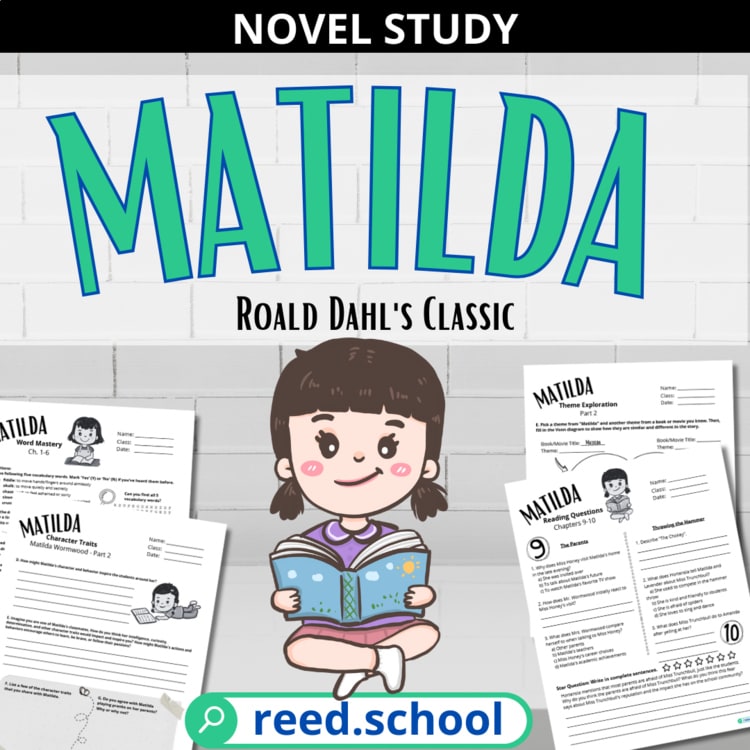
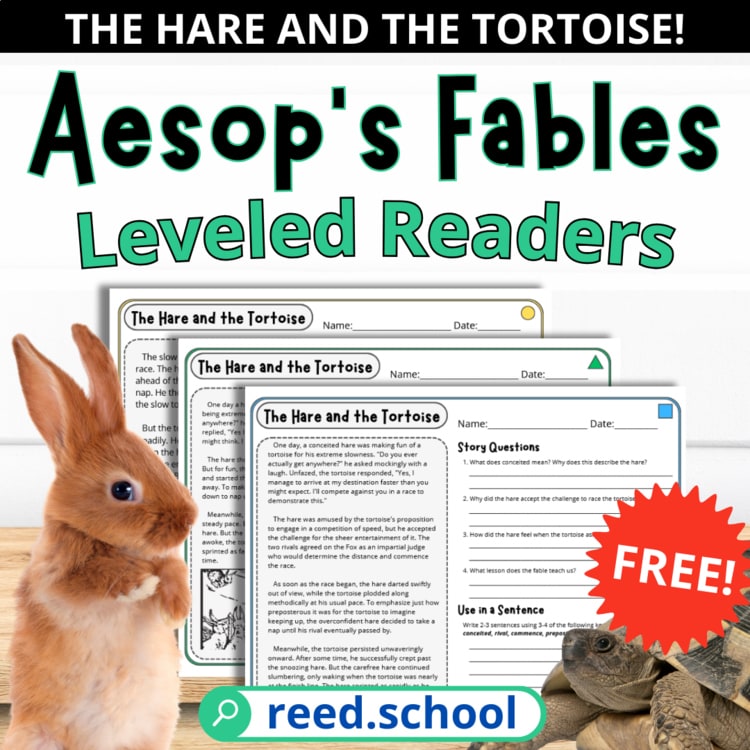
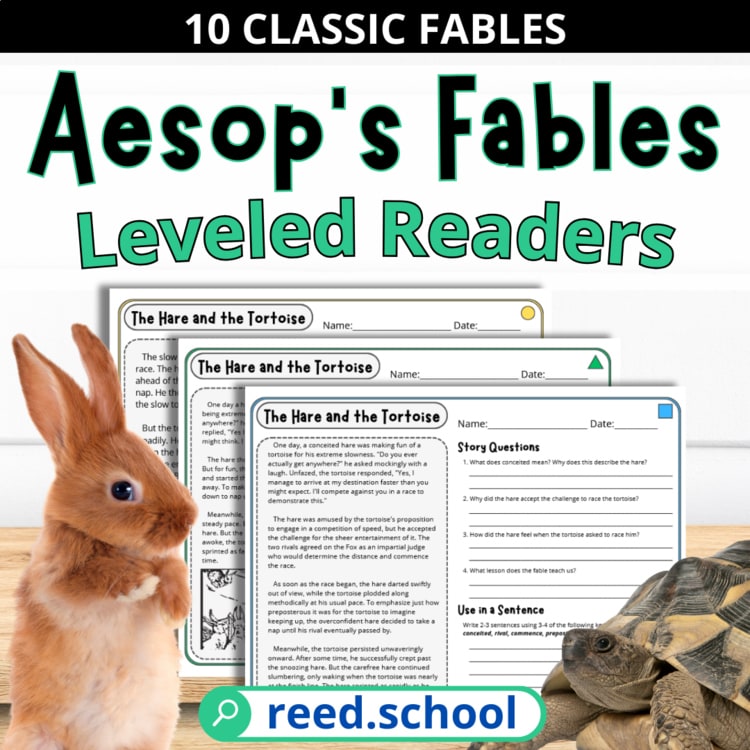
The Aesop’s Fables Leveled Readers and Matilda Novel Study provide ready-made opportunities to compare literal, inferential, analytical, and creative questions across short and extended texts.