American Revolution review often becomes a list of names, dates, and vocabulary. Retrieval matters, but students also need to connect events: why tensions increased, how people made choices, and how the war affected different communities.
A balanced review uses quick fact recall as the starting point and then asks students to organize, explain, compare, and support claims.
Separate “know” from “connect”
Create two kinds of review cards.
Know cards
- Define boycott.
- Identify the author of the Declaration of Independence.
- Name one advantage held by the British military.
- Locate the thirteen colonies on a map.
Connect cards
- How could a boycott create political pressure?
- Why did geography matter at Saratoga or Yorktown?
- How did the Declaration change the purpose of the conflict?
- Why might two colonists respond differently to the same event?
Students need both. Facts give them material; connections turn the material into history.
Build a cause-and-effect chain
Give groups event cards such as:
- French and Indian War
- British debt and new taxes
- Stamp Act protests
- Boston Massacre
- Tea Act and Boston Tea Party
- Coercive or Intolerable Acts
- First Continental Congress
- Battles of Lexington and Concord
- Declaration of Independence
Ask students to arrange the cards and draw arrows labeled with explanations. More than one event can contribute to another, and not every relationship is a simple single cause.
Require language such as:
This increased tension because…
This changed colonial action by…
This was a response to…
The labels matter more than a perfectly straight timeline.
Use a human timeline with turning points
Distribute event cards and ask students to stand in chronological order. Then introduce questions:
- Which event represents a shift from protest to armed conflict?
- Which event helped transform the conflict into a movement for independence?
- Which military or diplomatic developments changed the likelihood of victory?
- Where would you place a “turning point” label, and why?
Students may defend different turning points if they use evidence.
Compare perspectives without pretending all choices were equal
Use short fictionalized or source-based perspective cards representing:
- A Patriot merchant
- A Loyalist farmer
- An enslaved person considering offers of freedom
- A free Black soldier
- A woman managing a household or business during war
- A member of an Indigenous nation weighing alliances and threats
- A recent immigrant or religious minority
Ask what information, interests, risks, and constraints could shape each person’s choice.
Avoid turning perspective into “everyone simply had a different opinion.” Power, freedom, coercion, land, and survival were not distributed equally.
Add maps to the review
Students should be able to connect events to place. Use maps to ask:
- Why were ports important?
- How did rivers and roads affect movement?
- Why did distance from Britain matter?
- How did the Southern campaign differ from earlier fighting?
- Why was French naval support important at Yorktown?
A map question often reveals whether students understand the event or only recognize its name.
Use vocabulary puzzles as retrieval, not the entire assessment
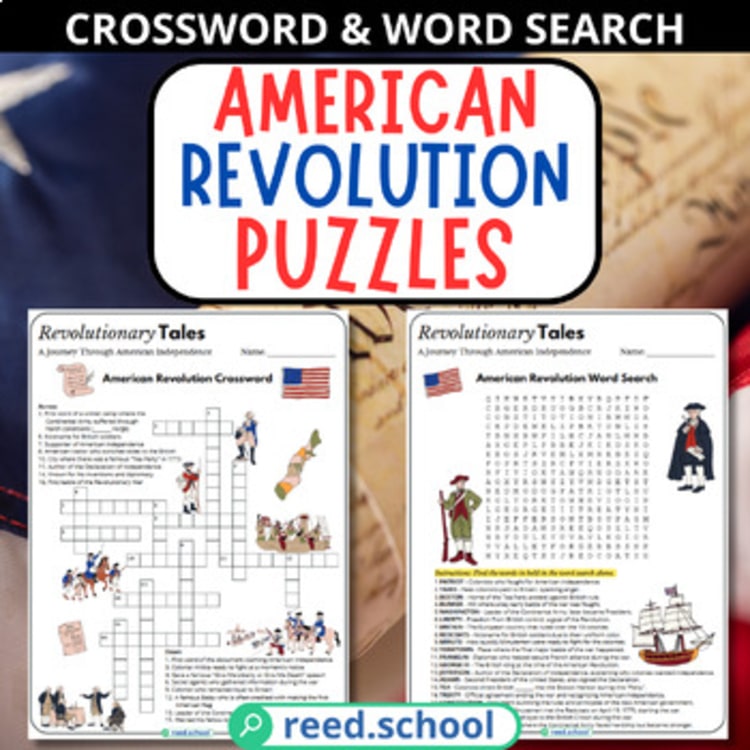
Crosswords, matching, and word searches can provide low-stakes recall and help students notice spelling and terminology. They work well as:
- A warm-up
- One station in a review rotation
- Homework after a discussion lesson
- An early-finisher option
- A quick sub activity
Follow the puzzle with one application question. After students find “boycott,” ask them to explain how a boycott attempts to create change.
The free American Revolution Puzzles include a crossword and word search with answer keys for this kind of retrieval practice.
Create a “most important” evidence sort
Give students six to eight event cards and a question:
Which three developments were most important in moving the colonies toward independence?
Students rank the cards, then defend the top three. Require them to compare:
___ was more important than ___ because…
There is no single required ranking if the evidence and reasoning are strong.
Use mistake analysis
Provide statements that are partly wrong:
- “All colonists wanted independence from the beginning.”
- “The Boston Tea Party happened because tea became more expensive.”
- “The colonists won only because they had a stronger army.”
- “The Declaration of Independence ended the war.”
Students identify the inaccurate part and rewrite the statement. This is more revealing than a simple true-or-false item.
End with a one-page synthesis
Ask students to complete four boxes:
- Cause: One development that increased conflict
- Turning point: One event that changed the direction of the struggle
- Perspective: One group whose experience complicates the usual story
- Legacy: One question or principle that continued after the war
Each box should include a fact and a sentence explaining why it matters.
Keep the final assessment connected
A strong short response might ask:
Choose two events and explain how the first helped create conditions for the second. Include one piece of evidence and one limitation or additional factor.
This rewards chronology, causation, and historical caution.
Use puzzles to build confidence, then move students toward the larger story: a conflict shaped by ideas, material interests, geography, international alliances, and the unequal pursuit of liberty.